Lafourche Parish walls and ceilings
Drywall Repair in Larose, LA
Storm-soaked walls, tan ceiling rings, AC drip damage and plain old holes, cut out or patched, texture-matched and finished with primer so nobody can point to where the damage was.
Call 7 days, 7am–9pm
Dial it and a drywall repairer from around the bayou rings back, gets the story and lines up your price.
Five minutes of prep
Pre-call kit
Gather a little first and the opening conversation is about your wall, not a quiz. None of this needs a ladder you don't already trust.
Photo pair
A tight shot plus a wide one from the doorway, so both size and lighting come through. For texting, daylight beats the overhead bulb.
Rough dimensions
Inches across and inches tall. Hold a dollar bill next to it if the tape measure has gone missing again.
The panel
Water above a ceiling light or fan? Kill that circuit at the electrical panel, ahead of the mop and the bucket.
Likely culprit
Roof, AC unit, plumbing or high water. A shrug is a fine answer. Tracking it down belongs to the repair.
Your deadline
A lease ending, listing photos or painters on the calendar. Dates change which room goes first.
Apparently a stain photographed at midnight looks like a map of somewhere else. Daylight helps.
Short answers
Gypsum questions
- Can anyone tell where the patch was?
- Not if it is finished right: coats spread wide, sanded flush, primed so it soaks paint the way the old surface does, and texture rebuilt on top. New paint beside old paint can still look a shade off, so rolling that whole wall is the safe bet.
- Is one little hole too small to bother with?
- No. Small repairs are priced like anything else. If the house has three or four, mention every one; the whole batch can go on one quote.
- Can my ceiling texture be copied?
- Usually. Popcorn, knockdown and orange peel each have a method, and a decent match starts with practice sprays on a scrap of board before anything goes overhead.
- How many days does it take?
- A small patch is mostly waiting on thin coats to dry, so it tends to stretch over two days. Water damage that has to dry out first takes longer. Muggy weather slows the mud too, which surprises nobody here.
- What about the dust?
- Cutting and sanding throw fine powder. Ask for plastic taped across doorways and a HEPA vacuum, and clear small things off nearby shelves ahead of time.
- Does the leak get fixed before the wall?
- It has to. Fresh drywall under an active leak becomes damaged drywall after roughly one storm. Roofing, plumbing or AC work happens first, then the board.
Four kinds of damage
Four repair lines
Nearly every wall or ceiling problem on this reach of the bayou fits under one of these headings. Cracks, popped nails and dented corners tag along with all four.
Water-damaged drywall
Board that drank storm or flood water, cut back past the wet line, dried out and rebuilt with fresh gypsum.
Ceiling leak repair
Tan rings, peeling tape and soft spots overhead, dealt with after the roof stops letting weather in.
AC drain leak repair
Rings under the attic air handler or a soggy closet wall, traced to condensate and mended once the drip quits.
Hole patching
Doorknob craters, furniture gouges and old anchor holes, filled or patched, then feathered until the old paint can't find the seam.
Size changes everything
Hole size tiers
How big the damage is decides how many coats it gets, how long they dry and how much wall ends up repainted. The drawing lines up the usual sizes at one scale beside an ordinary interior door.
Small
Nail holes, popped screws, dings and openings up to a couple of inches. Filled, given two or three skim passes, sanded and spot-primed. Touching up the paint is often the slowest bit.
Medium
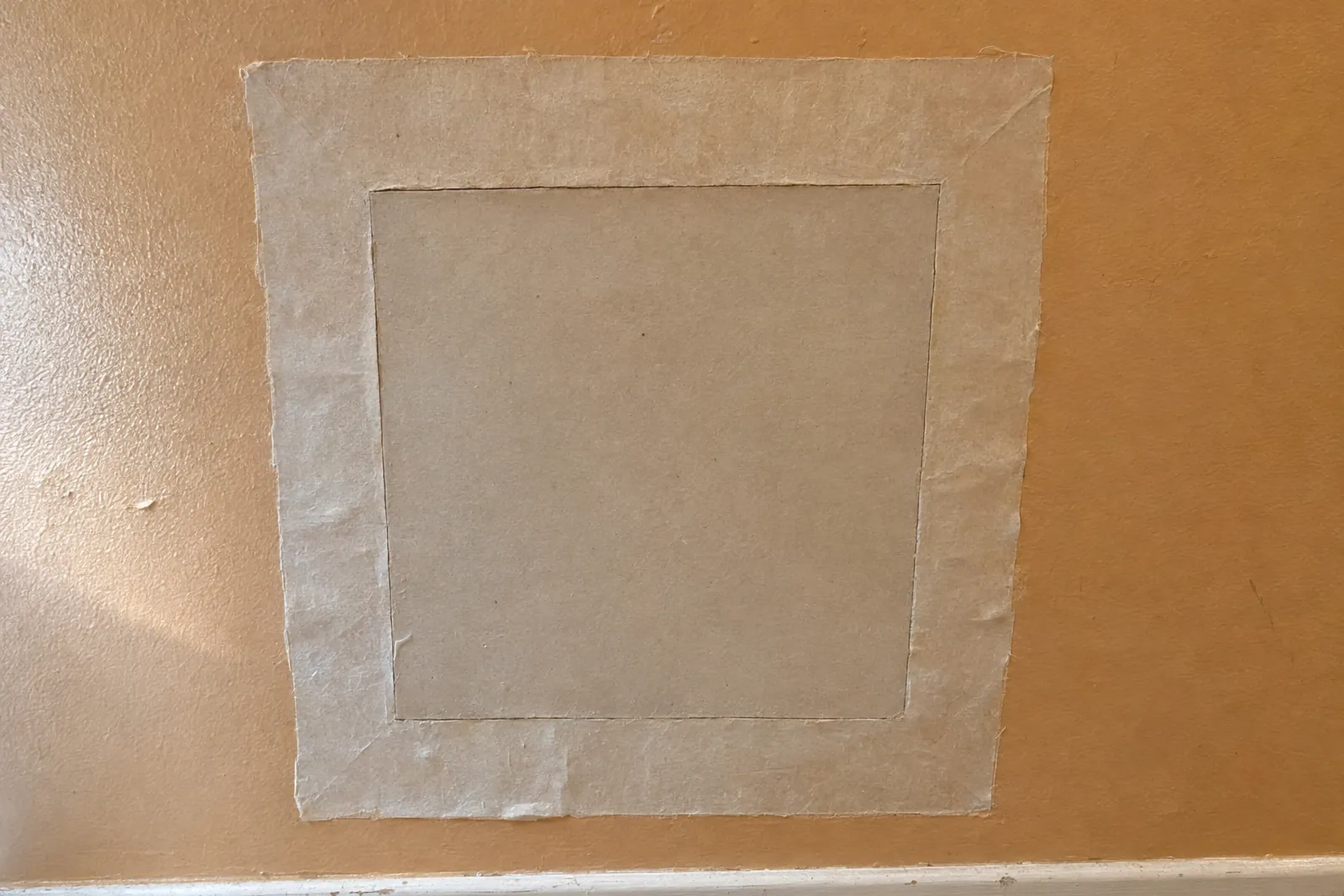
Doorknob damage up to around a foot wide. Crumbled gypsum is trimmed square, a backer or fitted piece goes in and is screwed, then tape and three coats follow with drying time between. Texture comes last.
Large
Half a sheet and up, nearly always from water. Board comes off the framing in a clean rectangle, new drywall goes onto the studs or joists, and every joint is taped and finished. Texture and paint blend over a wide area.
For a rough idea, Fixr's nationwide drywall price breakdown (January 2025 edition) gives about $60 to $200 for a hole, about $60 to $330 for a crack and about $400 to $800 for water damage, and puts labor around $70 to $80 an hour. Those numbers describe the country at large rather than a house in Larose. Size, ceiling height, texture, the amount of paint afterward and whether the board is still wet all push the number around.
Honest limits
Weekend patch limits
A homeowner armed with a putty knife, spackle and patience can manage some of this. Other jobs come back as the same hole, only bigger.
Fine for a homeowner
- Nail and screw holes in a smooth wall: lightweight spackle, a flat knife, a quick sanding and a dab of primer.
- A shallow ding where a chair or a vacuum handle bumped the wall, provided the paper face isn't ripped open.
- Hairline cracks you plan to watch for a while, filled with flexible patching paste until then.
Better left to a pro
- Anything that got wet. Soaked board needs readings and usually removal, not a fresh coat of paint.
- Ceilings. Working wet mud over your head is a sport of its own, and texture up there forgives nothing.
- Openings you could fit a hand through, crushed outside corners and cracks that reappear after filling.
- Textured walls where the repair has to vanish ahead of a listing or a lease ending.
For the curious, the drywall guides for Larose homes explain why a weekend patch so often shows through fresh paint.
Turns out the hardest part of a small patch is stopping after the second coat.
How it runs
Repair chronology
First message
By phone, by texted snapshot or through the form: the what, the where and a rough size.
The callback
A drywall repairer from the area hears the story, asks where the water or impact came from and arranges the quote.
Up-front figure
You hear a number for the repair before anything gets cut, coated or sanded, and the work waits on your yes.
Leak stopped
With water involved, the leak is repaired and the board dries. Moisture readings decide what stays.
Board work
Ruined drywall is removed or patched, and new pieces are fastened, taped and layered with thin coats.
Primed finish
Sanded, textured to match and primed, so the surface is set for its last coat of paint.
There is a little more on what Larose Drywall Repair does and how it works.
Up and down the bayou
Neighbors on the bayou
Bayou Lafourche and the Gulf Intracoastal Waterway cross in the center of Larose, and LA 1 and LA 308 run through it on opposite banks. Besides town itself, these places close by are covered.
- Cut Off. Cut Off touches Larose on the southeast, along Bayou Lafourche.
- Galliano. Galliano lies south of Cut Off on the same bayou.
- Golden Meadow. Golden Meadow is a town on Bayou Lafourche, farther southeast than Galliano, with 1,761 people in 2020.
- Lockport. Lockport is a town on Bayou Lafourche, northwest of Larose, home to 2,490 people in 2020.
- Mathews. Mathews, officially a census-designated place on Bayou Lafourche in the central part of the parish, sits with Lockport and Raceland on its borders and a 2020 headcount of 2,273.
- Raceland. Raceland, with 9,768 people in 2020 the biggest name on this list, is officially a census-designated place, sitting on Bayou Lafourche at the northwest end of the stretch covered.
The service area page gives each place a few lines of its own.
Fresh board, fresh cracks
First-year cracks and pops
Ida made landfall by Port Fourchon on August 29, 2021, and accounts of the storm record severe damage across coastal Louisiana. Any house with new gypsum, whether freshly built or rehung after a storm, goes through a stretch of small complaints early on: popped fasteners, hairline lines at inside corners and the odd joint showing a faint ridge.
Most of it is cosmetic. A popped nail is fixed by driving a screw just beside it, then spotting and priming. Corner lines get opened up, retaped and recoated. A line that keeps creeping wider month after month, or a ceiling joint that lifts each summer, deserves a look at what is moving underneath before anyone coats it again.
Moving or selling
Listing touch-ups
Landlords and buyers spot the same handful of things: anchor holes left by a wall-mounted TV, a doorknob crater behind a bedroom door, a faded ring on the hallway ceiling. Fix those. Scuffs that one coat of paint hides can wait for whoever paints.
When painters are already scheduled, book the drywall ahead of them and allow a day or two for the last coat to cure and get primed. Listing photos are harsher than buyers, oddly, since a camera flash at an angle shows every ridge that never got sanded.
Before a move-out walkthrough, put every repair in one message with pictures. A single price for six small holes beats having the same conversation six times.
Gulf Coast weather
Storm season and humidity
Houma's climate normals from NOAA, covering 1991 to 2020, come to 65.42 inches of rain and other precipitation over a typical year, and June and July carry the most. Some of that ends up indoors, usually in one of these ways.
Summer downpours
Heavy rain tests every roof vent and bit of flashing. A ceiling announces the failure as a tan ring that spreads after each storm.
Hurricane season
Wind shoves rain sideways under shingles and around window frames, so marks show up on walls as well as overhead.
Damp air
Humidity slows down joint compound and paint, and soggy board sealed up behind paint can grow mold out of sight.
AC season
Air handlers work long shifts. When the condensate line clogs, it spills into the closet or onto the ceiling below the attic equipment.
Storm water already inside the walls? The page on repairing storm-soaked drywall sorts out what gets removed and what can be kept.
When water gets in
Leak aftermath
Breaker and bucket
When a ceiling bulges or holds water, the breaker comes first: whatever light or ceiling fan hangs in that section loses power before anything else. Then nobody walks or stands underneath. A bucket, plus a small screwdriver puncture where the bulge sags lowest, lets the water out on your timing instead of gravity's.
Leak shutoff
Tarp the roof, close the water valve or switch the AC off at the thermostat. Nothing else counts while it still drips.
Drying period
Box fans, a dehumidifier and opened-up cavities. Soaked insulation above a ceiling keeps the board damp for days on end.
Moisture mapping
Readings show where the water wandered, which is often a good deal past the visible ring.
What stays
Board that stays mushy, crumbles or smells of mildew is replaced. Solid, dry board carrying nothing worse than a stain can be sealed and repainted.
Overhead trouble has its own page on ceiling stains and sags after a roof leak, and air conditioner drips are handled under condensate leak damage. Ordinary holes live on the page about hole patching and dents.
Your move
The quote conversation
Explain what your wall or ceiling went through, even if the explanation is a shrug. We'll pass it along to a drywall repairer nearby, who discusses it with you and settles the cost before a single cut.
A drywall repairer from this end of the parish picks up the details and rings back to talk price.